Warrant Records provide instant access to Sedgwick County sheriff data through the official website search portal at https://ssc.sedgwickcounty.org/warrantsearch/. By using the warrantrecords login you can run a warrantrecords online search, check warrantrecords case status, and request a warrantrecords PDF download. The warrantrecords phone number (316) 660‑3960 connects you to the office at 141 W. Elm, Wichita, KS 67203 during Monday‑Friday, 8 AM‑5 PM. Fees are minimal and a warrantrecords documentation request is processed on‑site.
For users needing a warrantrecords inmate lookup or a warrantrecords background check, the portal aggregates criminal history, court records, and misdemeanor records in a single view. You can also perform a warrantrecords felony warrant search or an arrest warrant lookup without leaving the site. The warrantrecords record retrieval guide explains how to access warrantrecords public records, request a subpoena, and understand any status changes such as recalled or quashed warrants.
How to Search Warrant Records
Warrant Records from the Sedgwick County Sheriff’s Office can show whether the office lists a warrant and the status attached to a matching entry. The search covers records handled by that office, not a full criminal history, inmate roster, or court docket from every Kansas county. Individuals can also check active warrants to verify relevant details. Use the official portal for a current check, then confirm time-sensitive results with the issuing court or law-enforcement agency. A search entry does not prove a person’s identity, guilt, or conviction.
Official Search Portal: https://ssc.sedgwickcounty.org/warrantsearch/
Steps to Search
- Open the official portal and enter the person’s full legal name, including a middle name or initial when the form requests it.
- Add a birth date or another identifying field only if the portal provides that field and the value is known.
- Review every matching entry, including the warrant number, type, issuing authority, status, and dates shown by the portal.
- Compare multiple matches using the warrant number, court, agency, and status so entries for different people are not mixed together.
- Use a print or save-as-PDF option if one appears for personal reference. Ask the records custodian for an official certified copy when a court, employer, or other agency requires one.
Sedgwick County KS Warrant Records
The Sedgwick County Sheriff’s Office operates the county’s public warrant-search portal. A Kansas warrant normally begins through a court process in which a judge reviews charges and supporting documents, then issues an order that law enforcement may execute. The Sheriff’s Office handles the records assigned to it and records actions such as service or cancellation. A portal entry is an enforcement record, not a replacement for the complete court file.
Scope of the Sheriff’s Office Search
The portal covers records handled by the Sedgwick County Sheriff’s Office. It is not a statewide warrant service, a federal warrant search, or a complete index of warrants handled by every police agency in the Wichita area. A missing entry may mean that the office holds no matching warrant, the entered name does not match its indexed record, a recent entry has not reached the portal, or the warrant belongs to another jurisdiction.
Use only the public search fields presented by the official portal. A separate warrantrecords login should not be assumed. If the site asks for sign-in or payment details, confirm the full web address before entering personal data, and do not use a lookalike third-party site that requests credentials for an unrelated service.
What Each Record Answers
Several related searches may appear similar, but each answers a different question. Knowing which source handles the record prevents a warrant result from being mistaken for a complete criminal or court history.
- A warrant record shows whether the Sheriff’s Office lists a warrant and the status assigned to that entry. It may not contain every charge, filing, hearing, or sentence in the case.
- A court record shows case activity such as charges, filings, hearings, rulings, and disposition. The Kansas district court clerk for the proper county is the source for those court events.
- A criminal-history or background-check search covers a broader set of records and may include convictions and sentences. One warrant entry alone cannot serve as a full criminal-history report.
- An inmate lookup shows whether and where a person is held in custody. Custody and warrant status are separate matters, and a person can have a warrant without being in jail.
Account and Portal Use
Use the portal as a public search tool and save the date of each check. Court orders, arrest records, and agency status changes may reach public indexes at different times. A result that appears current on one day may change after service, recall, quashing, or a court order, so repeated checks should include a fresh search date.
Types of Warrant Records
Different warrants serve different legal purposes. The portal’s label provides the quickest clue, while the issuing court file explains the underlying case and the exact reason for the order.
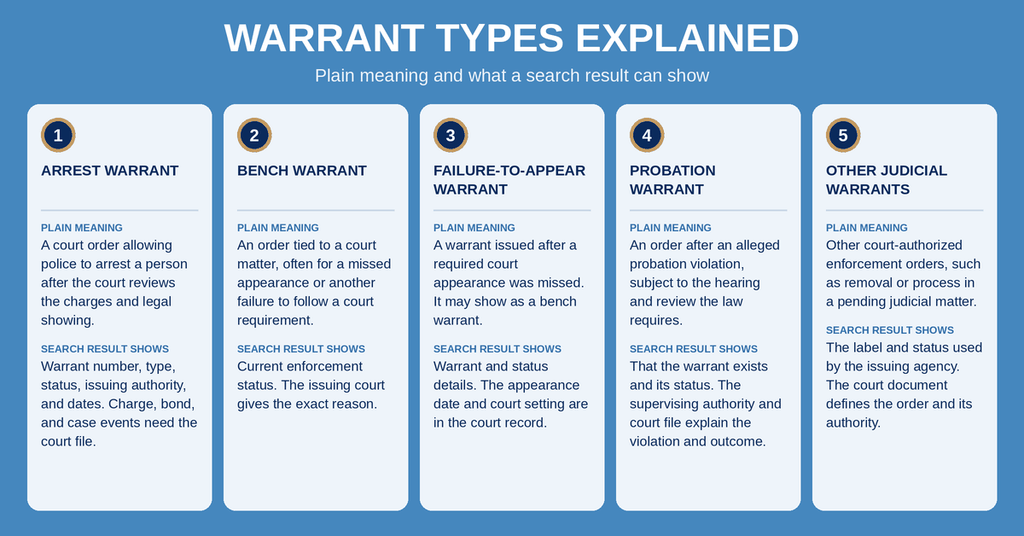
Warrant labels vary among courts and agencies. A charge may be classified as a misdemeanor or felony, yet the warrant entry may show only a general warrant type. Read the case or warrant number and confirm the charge classification with the issuing court rather than guessing from the search label.
Warrant Status and Disposition
Warrant status describes the current enforcement stage of an order. It does not replace the disposition of the underlying criminal case. The court controls the case and legal orders, while the Sheriff’s Office records the service activity assigned to that office.
Active Warrants
An active warrant is one that the office lists as outstanding and has not recorded as served, recalled, or quashed. The order may remain executable under applicable law. An active status does not show that a case has ended, and it does not replace the court’s findings or judgment.
Served Warrants
A served status means law enforcement has executed the warrant, often by making an arrest. Service completes one stage of the warrant but does not mean the person was convicted. The arrest may lead to a bond hearing, charges, a plea, trial, or another court outcome shown in the case file.
Recalled Warrants
A recalled warrant has been withdrawn by the proper issuing authority before service. The supporting court document defines the reason and the party or office responsible for the recall. A recalled entry may remain visible for a period because public systems often retain historical enforcement data.
Quashed Warrants
A quashed warrant has been canceled by a court order. Quashing and recall can lead to different paperwork even though both stop enforcement of the order. Confirm the source document before telling another party that a warrant has been quashed.
Expired Warrants
An expired warrant is no longer active under the terms of the order or applicable law. The reason for expiration can depend on the warrant type, its age, and a statutory limit. A result that later disappears from the portal does not by itself reveal whether it expired, was recalled, was quashed, or moved to an archive.
Status Changes
Status changes occur after the office receives documentation such as a return of service, recall notice, or court order. The dates displayed may represent the court event, the agency’s receipt, or the portal entry date. For a matter that cannot wait, confirm the status with the issuing authority and record both the confirmation date and the source.
Warrant Record Identification
A name search compares the typed name with names indexed in the warrant system. Common names, spelling differences, aliases, and incomplete middle names can create both false matches and missed matches. Each result needs a careful identity check before it is used for any purpose.
Matching the Correct Person
Enter the person’s full legal name as it appears on a court document or other reliable source. If the form requests a birth date, use the exact value rather than an estimate. Names with accents, hyphens, or multiple given names may be indexed in different forms, so a missed search can require a spelling variation that is supported by known facts.
Matching the Warrant Number
Treat a warrant number as a precise reference within the system that issued it. Copy the number rather than typing it from memory, and compare each digit and prefix. Users can also reference bench warrants for additional information. A number from another county, court, or agency may not match the Sedgwick County index even when the person’s name is correct.
Identifying the Issuing Authority
The issuing authority is the court or judicial body that ordered the warrant. The enforcing agency is the law-enforcement office responsible for carrying it out. These may appear as separate fields or may be shown together. The county and state listed with the result help determine whether the Sedgwick County Sheriff’s Office is the correct agency to contact.
Distinguishing Multiple Warrants
Several rows can belong to one person because a case may produce more than one order or because the same name belongs to different people. Do not count result rows as a count of people. Compare each row with the known name, warrant number, type, court, issuing date, and status before drawing a conclusion.
Checks for Each Match
Run these checks against every matching row:
- Confirm the full name, including middle name or initial where available.
- Compare the exact warrant or case number.
- Match the warrant type with the known legal process.
- Confirm the issuing court and enforcing agency.
- Note the status and the date attached to that status.
- Look for differences that suggest a separate person with the same name.
Keep a copy or written note of each match. The identifying fields are often needed when asking a court clerk or records custodian to confirm the entry.
Warrant Record Availability
Availability depends on the office’s retention rules, the type of warrant, court orders, and the rules governing public access to the file. A live search portal serves current enforcement needs, but it may not contain every record from every stage of a case.
An absent search result does not prove that no warrant exists. A name mismatch, indexing delay, another jurisdiction, a sealed file, or removal from the public index can each produce the same empty result. State the exact search name and date when asking a custodian to check beyond the live portal.
Warrant Record Updates
A warrant record changes as court orders and enforcement actions occur. The public entry may not update at the same moment as the underlying event because each office records its own actions. The update process can include several separate steps.
Newly Issued Warrants
A newly issued warrant must pass through the court, clerk, law-enforcement agency, and public indexing process before it appears in a search portal. No fixed public update time should be assumed. A warrant issued or transmitted recently may remain absent until the agency records it and the portal updates.
Served Warrant Updates
A service update follows documentation that an officer executed the warrant. The record may show a service date, return status, or a later inactive label. The service date and arrest date can differ because processing and reporting take time. Service also remains separate from the later court disposition.
Recalled and Quashed Warrant Updates
A recall withdraws an outstanding warrant, while a court quashing order cancels it under judicial authority. The office needs the proper paperwork before changing its system. An entry may stay visible during that process, and the public wording may not reveal the exact source document until the update is complete.
Corrected Warrant Details
A corrected entry may fix a misspelled name, wrong case number, agency code, address, warrant type, or status. The warrant number may remain the same because the correction changes data rather than creating a new order. A date shown near the corrected entry may be the amendment date instead of the original issuance date.
Removed or Archived Entries
An entry may leave the live index because of retention, archiving, a correction, or a system change. Disappearance does not establish the reason by itself. Anyone relying on an older entry should preserve a copy and ask the custodian whether the warrant was served, recalled, quashed, expired, or transferred to an archive.
Warrant Record Accuracy
A public warrant entry is an administrative summary. It can contain typing errors, incomplete names, delayed status changes, or records indexed under a different name. Verification should use the strongest available source for the specific question.
Verifying Warrant Details
Compare the search result with the underlying court or agency record. Check the legal name, warrant number, type, issuing authority, dates, and status as separate fields. For a legal or court question, ask the issuing clerk to confirm the entry from the court file rather than relying on a name-only internet result.
Checking Current Status
Read the status label and the date attached to the result, then run a fresh search before relying on it. A result marked active may still have a pending court action, and an entry marked served may still have an open case. Direct confirmation from the issuing authority is the proper step for a deadline, hearing, arrest, or other urgent matter.
Confirming Record Currency
Record dates may refer to different events. One date can show when the warrant was issued, while another shows when the office last updated or returned it. The portal does not always label every date with the same wording, so each date should be read in its displayed context.
Identifying Duplicate Entries
Two rows with the same name do not necessarily represent duplicates. A true duplicate usually shares the same warrant or case number and matching core details. You can also consult booking releases to locate official filings. Entries with different numbers, courts, types, or statuses should be treated as separate orders until the source record says otherwise.
Reporting Incorrect Details
Report a suspected error through the Sheriff’s Office or the office connected with the source record. Include the exact search name, result date, warrant number if shown, the incorrect field, and the correct value when known. A saved copy or screenshot can help the office locate the same entry, but personal data should be shared only through an official channel.
Copies, Certified Records, and Public Records Requests
An online result, a printed page, a saved PDF, and a certified record serve different needs. The first three may help a person review a search, while a certified copy carries authentication from the office that holds the record. A federal or state background-check provider may apply its own certification rules.
Warrant records PDF Download
For a warrant records PDF download, use the print or save function offered by the browser or official portal. Label the file with the person’s name, search date, and warrant number so it can be identified later. Saving a page as a PDF does not add a custodian’s seal or make the copy certified.
Documentation Requests
The Sheriff’s Office handles documentation requests on-site. Ask which records the request covers, whether a form is required, what identification is needed, and the current fee before submitting a large request. A court file must be requested from the clerk of the court that created it because the Sheriff’s Office may hold only the enforcement record.
Certified Copies
A certified copy is authenticated by the custodian of the record. The Sheriff’s Office can certify records within its custody, while a district court clerk can certify court filings and orders. Ask the receiving court or agency which form of certification it accepts before ordering. A portal printout, email copy, or ordinary PDF normally does not replace that step.
Record Fees
Record-copy fees are described as minimal, but the exact charge depends on the request. Ask for the current amount and accepted payment method before ordering documents. Even when a warrant search is free, a copy, certification, postage, or larger production request may carry separate charges.
Subpoena Process
A subpoena is court-process used in litigation, not the normal method for requesting an agency’s public records. A person seeking records without a pending case should use the public-records request process for the agency that holds them. The Kansas Open Records Act, K.S.A. 22-3427 and following, supplies the legal framework and procedures for requests to public agencies.
If a court case requires records from the Sheriff’s Office, the attorney or court handling that case should determine whether a subpoena, request, or other legal process applies. Sending a subpoena to the office without court direction does not create the same process as an ordinary public request.
Search Problems
Most failed or confusing searches involve a name mismatch, another jurisdiction, or a record that has not reached the public index. A new search, a careful field comparison, and confirmation from the source can prevent an incorrect conclusion.
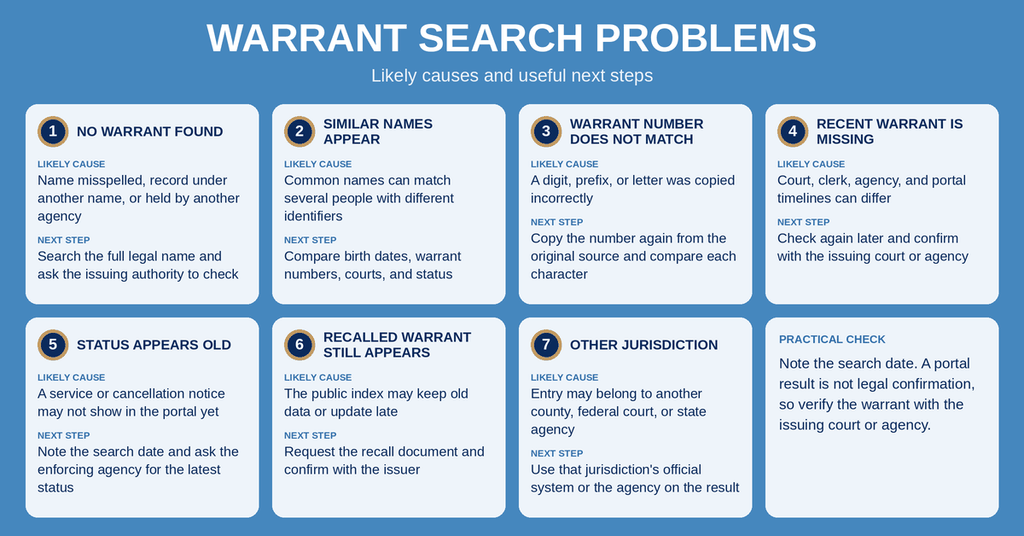
For any serious decision, record the date of the search and the source consulted. A portal result is one piece of the verification process, not the final word on every legal question.
Contact Information
Use these contact details for questions about the warrant search, document requests, or a reported record error. Have the person’s legal name, warrant or case number, issuing court, and reason for the request ready before contacting the office.
Frequently Asked Questions
Below are common questions about searching and obtaining warrant records from the Sedgwick County Sheriff’s Office. Each answer gives clear steps, contact details, and fee information you may need.
How can I search warrant records online?
Visit the official portal at https://ssc.sedgwickcounty.org/warrantsearch/. Enter the full name or case number of the individual you are checking. The system returns any active warrants recorded by the Sedgwick County Sheriff’s Office. Results show the warrant type, issue date, and current status. Remember that the portal only covers warrants in Sedgwick County; for broader criminal history, contact the court or other law‑enforcement agencies.
What is the warrant records phone number?
The direct line for warrant inquiries is (316) 660‑3960. Call during office hours, Monday through Friday, 8:00 AM to 5:00 PM. A clerk can confirm whether a warrant exists, provide status updates, and explain next steps for resolution. If you need to speak with a specific division, ask the operator to connect you to the warrants unit.
Where is the warrant records office located?
The office sits at 141 W Elm, Wichita, KS 67203, inside the Sedgwick County Sheriff’s Office building. You can walk in during regular business hours to request copies of warrant documents or to verify information in person. Parking is available in the lot behind the building, and the location is near downtown Wichita for easy public transit access.
How much are fees for a warrant records request?
Fee amounts depend on the document type. Standard copies of warrant notices cost $5 per page. Certified copies, which require a seal, are $10 per page. Requests for bulk records or expedited service may incur additional charges. Payment is accepted by cash, credit card, or check at the records desk. Ask the clerk for an exact total before completing your request.
Can I lookup misdemeanor and felony warrants?
Yes. The online search portal lists both misdemeanor and felony warrants issued by the Sedgwick County Sheriff’s Office. After entering a name, the results indicate the warrant classification, charge, and whether it is active or satisfied. For felony warrants, additional details such as bond amount may appear. If a warrant is not shown, contact the court that issued it to verify the record.